The principle: free heat from the air
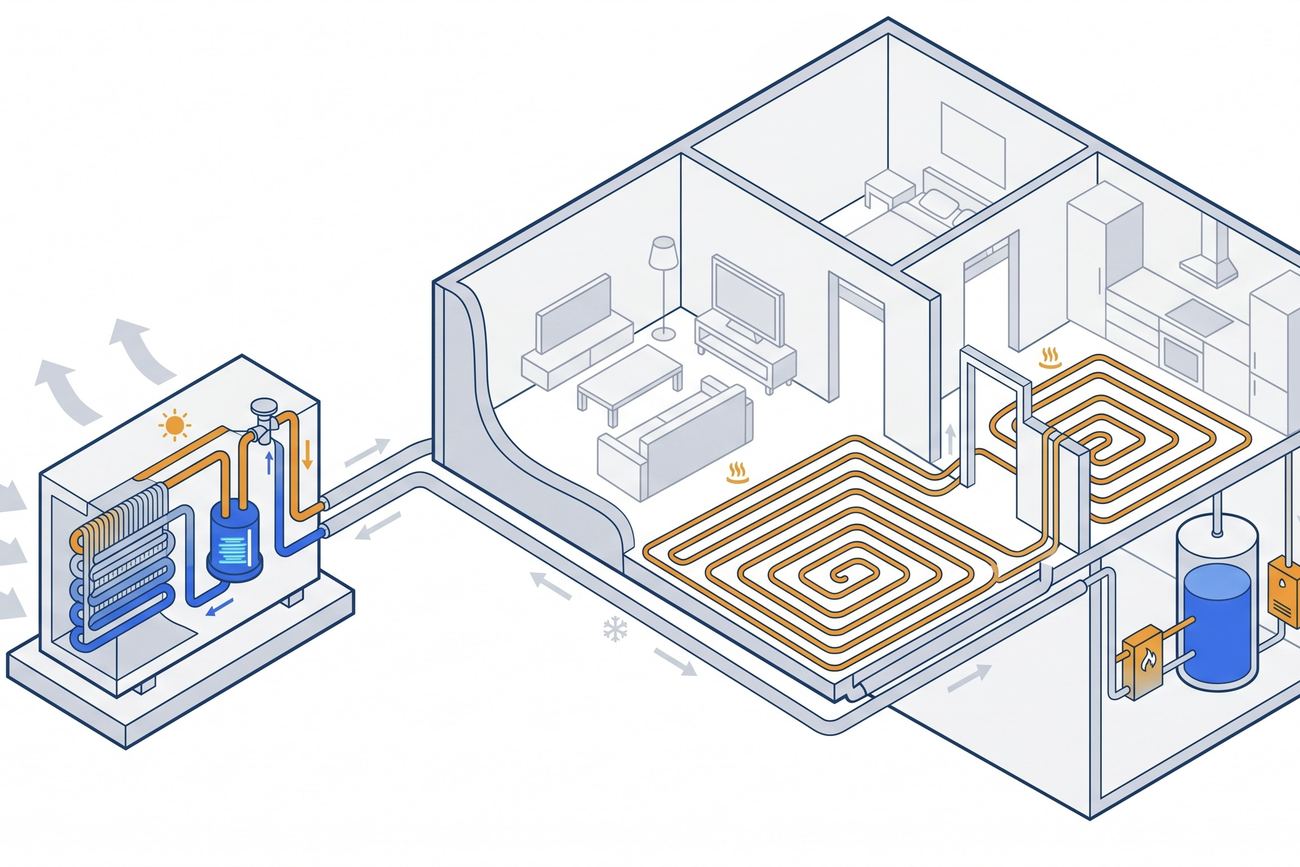
A heat pump is, put bluntly, a refrigerator running backwards. Where a fridge moves heat out of the cold compartment and dumps it behind the appliance, a heat pump moves heat into the house: it draws energy out of the outdoor air — even when the temperature is well below freezing — concentrates it, and delivers it as warm air through your ducts or as hot water to a hydronic loop.
The mechanism relies on a refrigeration circuit with a fluid that boils at very low temperatures. When outdoor air passes across the evaporator coil, it gives up heat to that fluid, which evaporates and is then compressed. Compression drives its temperature up sharply: the hot gas hands its energy to the heating side before the fluid condenses and the cycle starts again. At a seasonal COP of 3.0 this means, in practical terms, that the heat pump delivers roughly 3 kWh of heat for every 1 kWh of electricity it draws. The other 2 kWh arrive free from the outdoor air.
The types of heat pump
Cold-climate ducted (ccASHP)
This is the most common choice in Canadian detached homes that already have ductwork. The outdoor unit connects to your existing duct system and handles both space heating and summer cooling, usually alongside the furnace as a backup on the coldest nights. Advantages: high efficiency, works with most existing houses, drops straight in as a replacement for an oil or propane furnace, and qualifies for the largest rebates. Drawbacks: the outdoor unit makes noise and the ducts may need resizing if they were built for a high-temperature furnace.
Ductless mini-split
Delivers warm air directly into the room through one or more indoor heads: the familiar reversible wall unit. Advantages: lower cost (starting around $3,000 installed for a single zone), quick installation, summer cooling included, no ductwork required. Drawbacks: it does not make domestic hot water, it performs poorly in houses chopped into many small rooms, and a single head cannot carry a whole home. It suits condos, additions, basements and houses with no ducts at all.
Ground source (geothermal)
Draws heat from the ground through buried horizontal loops or a vertical borehole. Advantages: the highest efficiency available (seasonal COP up to 4.5), no noisy outdoor unit, long service life (over 25 years), and the largest rebate in Ontario at up to $12,000. Drawbacks: it needs a large lot or expensive drilling; installations typically land between $25,000 and $35,000 before rebates, and loop fields need municipal and conservation-authority approvals.
The installation in 5 stages
Site visit
We check insulation, ductwork, the electrical panel and where the outdoor unit can sit. Typically 45–60 minutes.
Sizing
Heat loss calculation to CSA F280-12 and selection of capacity. This is how undersizing is avoided.
Rebates and permits
Home Renovation Savings paperwork through a registered contractor, plus the ESA electrical permit and, where gas equipment is touched, the TSSA notification.
Installation
Setting the outdoor unit on its pad or brackets, running the line set, wiring the new circuit, fitting the air handler. Two to three working days.
Commissioning
Setting the changeover point, verifying performance, ESA inspection certificate and the written handover package.
Decommissioning the furnace and the chimney
Switching to a heat pump almost always means retiring the combustion appliance, and this is where a lot of projects get complicated. Pull a mid-efficiency gas furnace off a masonry chimney and you leave the gas water heater orphaned: it is now venting on its own into a flue sized for two appliances, the exhaust cools too fast, condensation attacks the liner and in the worst case the draft reverses into the house. The flue has to be relined to the correct diameter under CSA B149.1, or the water heater has to be moved to a power-vent or heat-pump model at the same time.
If a second combustion appliance stays in the house — a wood stove, a fireplace, a gas range — the picture changes again: the vent has to be verified, often relined, and the combustion air openings for the room have to be rechecked. This work falls under the same TSSA fuels registration the heating system itself requires, and giving it to the company that is also doing the heat pump avoids the familiar finger-pointing between two trades.
Running costs and maintenance
A modern heat pump needs surprisingly little maintenance. Most manufacturers recommend one annual service visit (roughly $150–$250) during which the refrigerant charge is verified, the evaporator fins are cleaned and the controls are updated. Beyond that, it is enough to keep the outdoor unit clear of leaves, ice and drifting snow, and to keep it up off the ground on a stand so a February snowbank does not bury the coil. Expected service life on a properly sized air source system is 15–20 years; the compressor, the most expensive component, generally carries 5–10 years of warranty from the better manufacturers.
Two requirements get overlooked in Canada more than any others: the ESA inspection certificate for the new circuit has to be issued and kept with the house records, and anyone opening the refrigerant circuit must hold an ozone depletion prevention (ODP) card, with leak checks on larger charges required under the federal Halocarbon Regulations. Ask for both before any work starts.
Rebates and incentives
Home Renovation Savings is the Ontario program, delivered by Enbridge Gas and Save on Energy with support from the provincial government, and it is the main channel for replacing a combustion system with a heat pump. For a home currently heated with electricity, oil, propane or wood, an eligible cold-climate air source heat pump earns $1,250 per ton, to a maximum of $7,500; a ground source system earns $2,000 per ton, to a maximum of $12,000. For a home heated with Enbridge natural gas the amounts are $500 per ton to a maximum of $2,000, or a flat $3,000 for ground source. A heat pump water heater adds $500 and a smart thermostat $100. Three or more qualifying upgrades under the assessment stream add a $500 bonus. The rebate is paid out through a contractor registered with the program, which is why it is worth checking registration before you sign anything.
What is already closed. The Canada Greener Homes Grant stopped taking new applicants in February 2024. The interest-free Canada Greener Homes Loan of up to $40,000 closed to new applications on October 1, 2025 — approved loans are still being serviced, but the portal is shut. The Oil to Heat Pump Affordability program took its last applications on July 31, 2026. If someone is still advertising any of these to you in 2026, they are selling from an out-of-date brochure.
What is coming. On October 8, 2026 the federal government announced a National Heat Pump Rebate worth up to $10,000 for households below the median income and $2,000 for everyone else, due to open in early 2027. The no-cost Canada Greener Homes Affordability Program for low- and median-income households is already running through provincial delivery partners.
We do not provide financing, we are not credit brokers and we do not sell financial or insurance products: we are an installation company. What we do is produce the correct technical documentation for a rebate application. Any tax or credit decision belongs with your own accountant or your own lender.
Heating systems compared
| Cold-climate heat pump | Natural gas furnace | Propane furnace | Electric baseboards | |
|---|---|---|---|---|
| Annual cost (1,500 sq ft, zone 6) | Approx. $1,000 | Approx. $900 | Approx. $2,900 | Approx. $2,900 |
| CO2 (t/year) | 0.2 | 3.6 | 4.1 | 0.5 |
| Expected service life | 15–20 years | 15–20 years | 15–20 years | 20+ years |
| Up-front investment | $12,000–$18,000 approx. $6,500 after rebates |
$4,500–$7,500 | $5,000–$8,000 | $2,000–$4,000 |
| Summer cooling | Yes | No | No | No |
Indicative figures for a detached 1,500 sq ft home in climate zone 6 (southern Ontario) with a heating demand of roughly 18,000 kWh per year, at $0.16/kWh blended electricity and $0.45/m³ all-in natural gas. Where natural gas is available it remains the cheapest fuel to burn in Ontario; the money is made by replacing oil, propane, wood or electric resistance heat, which is also where the rebates are largest. Actual costs depend on insulation, your utility rate, climate zone and how you run the system.